
SPARE PARTS for forklifts: distributor
2026-07-12
- Distributor for a loader: why it is the heart of the hydraulic system and how not to make a mistake when choosing spare parts
- Design and principle of operation: what is hidden inside the case
- Valves typology: monoblock vs sectional solutions
- Selection criteria: technical parameters that cannot be ignored
- Original versus analogue: savings or risk?
- Diagnosis of faults: when is it time to change the distributor
- Installation and maintenance: extending the life of hydraulics
- Logistics and purchasing: how to optimize the supply of spare parts
- Frequently Asked Questions
- Conclusion: Investing in Reliability
Distributor for a loader: why it is the heart of the hydraulic system and how not to make a mistake when choosing spare parts
In our practice of working with imported special equipment, we have repeatedly encountered a situation where the downtime of a loader due to the failure of one component cost the enterprise more than the cost of the assembly itself. The key element that determines the speed, smoothness and safety of the boom and bucket is the hydraulic valve. RequestSPARE PARTS for forklifts: distributoroften searched by engineers and purchasers who are faced with a drop in equipment performance or oil leaks. This part does not just direct the flow of working fluid - it controls the kinematics of the entire machine.
Many owners of warehouse equipment make the fatal mistake of choosing a distributor solely based on price or the external similarity of the housing. However, internal tolerances, spool material, and seal type are critical to the life of the pump and cylinders. In this article, we will analyze the technical nuances of selection, compare original components with high-quality analogues, and give clear instructions for diagnosing faults. Our goal is to help you make informed decisions that will keep your fleet running smoothly for years to come.
Design and principle of operation: what is hidden inside the case
A hydraulic distributor (hydraulic valve) is a complex mechanical unit whose task is to direct the flow of working fluid (hydraulic oil) from the pump to the actuators (lift, tilt cylinders and additional equipment) and back to the tank. Understanding the internal architecture is essential for proper diagnosis and replacement selection.
The main operating element of most modern forklift distributors is the spool. This is a precision part that moves inside the liner, opening and closing passages for oil to pass through. The quality of surface treatment of the spool determines the level of internal leakage. If the gap between the spool and the liner exceeds factory tolerances (usually micron values), some of the oil does not go into the cylinder, but is dumped back into the tank. This leads to the “failure” of the load under its own weight and slow operation of the hydraulics.
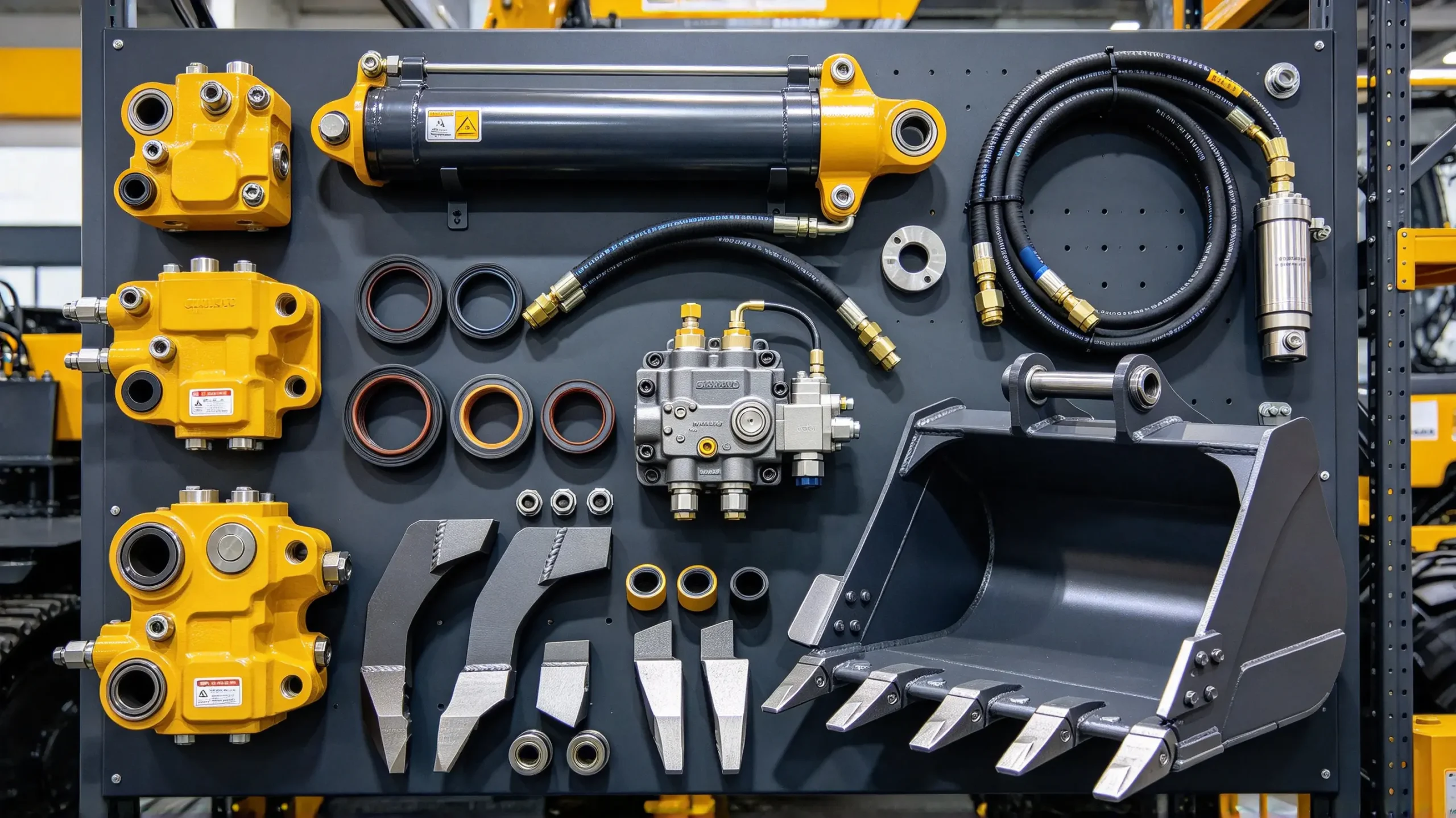
In modern systems, sectional distributors are often used. Each section is responsible for a separate function: lifting, tilting the mast, lateral displacement of the carriage or operation of attachments (rotator, gripper). The advantage of this design is its modularity: if one section fails, there is no need to replace the entire unit. It is enough to replace the damaged module, which significantly reduces repair costs.
An important component is the safety valve, either built into the distributor body or installed separately. It protects the system from overpressure. If the pressure reaches a critical level (for example, when the bucket hits an obstacle), the valve opens and dumps oil into the tank. Incorrect adjustment of this valve may result in rupture of the high pressure hoses or damage to the pump. We recommend checking the set pressure every 500 hours.
Another critical element is the load compensation system (LS system) in higher-end models. It allows you to adjust the oil flow depending on the resistance, ensuring smooth movements regardless of the weight of the load. For simple warehouse forklifts, open centers are more common, where oil is constantly circulated through a distributor in the neutral position. The choice between these systems depends on the intensity of use of the equipment.
Practical advice:Always remove the serial number from the old distributor before ordering parts. Even if the parts are visually identical, the internal passages may have different diameters, making the new assembly incompatible with your hydraulic design.
Valves typology: monoblock vs sectional solutions
When searching for a querySPARE PARTS for forklifts: distributoryou will inevitably come across two main designs: monoblock and sectional. The choice between them is dictated not only by budget, but also by the hydraulic system architecture of your specific forklift.
Monoblock distributors
The monoblock is a single cast housing, inside of which all the necessary channels are drilled. The spools are installed in this common housing. The main advantage of this design is compactness and high rigidity. The absence of external connections between sections minimizes the risk of external oil leaks. Monoblocks are most often found on compact electric loaders and small-tonnage equipment (up to 1.5–2 tons).
However, monoblocks have a significant drawback: maintainability. If the seat of one spool wears out or the housing cracks, the entire assembly must be replaced. Boring and restoring a monoblock under service conditions is often not economically feasible due to the high cost of the work and the difficulty of maintaining the geometry of the channels.
Sectional distributors
Sectional units are assembled from separate modules fastened with long bolts. Sealing gaskets are installed between the sections. This design dominates the segment of diesel and gas forklifts with medium and heavy lifting capacity (from 2.5 tons and above). The main advantage is flexibility. You can add a section for a new hydraulic cylinder (for example, to move a carriage) simply by adding another module to the assembly.
Repairing a sectional distributor is easier and cheaper. You can only replace the section that has failed. In addition, it is easier to upgrade the system by replacing the standard section with a section with proportional control for more precise control of movements.
| Characteristics | Monoblock distributor | Sectional distributor |
|---|---|---|
| Tightness | High (minimum external joints) | Medium (risk of leakage between sections) |
| Maintainability | Low (replacement of the entire unit) | High (replacement of individual sections) |
| Repair cost | High | Low/Medium |
| Application | Electric forklifts, mini equipment | Diesel/gas forklifts, heavy equipment |
| Possibility of modernization | Missing | High (adding sections) |
When choosing, keep in mind that the transition from a monoblock to a sectional system requires modification of the hydraulic lines and fastenings, which is often impossible without major design changes to the loader frame.
Selection criteria: technical parameters that cannot be ignored
An error in selecting a distributor leads not only to equipment inoperability, but also to the risk of emergency situations. When you submit an application forSPARE PARTS for forklifts: distributor, make sure the following key parameters are taken into account. Ignoring at least one of them can lead to rapid failure of the new node.
1. Nominal pressure and oil flow
Each distributor is designed for a specific maximum operating pressure (usually measured in bar or MPa) and nominal flow rate (l/min). Installing a unit with less pressure than the system requires will cause the relief valve to continually trip and overheat the oil. If the flow rate is insufficient, the load lifting speed will be lower than the design one, which will reduce the efficiency of the warehouse.
Check the specifications of your hydraulic pump. The distributor flow should match or slightly exceed the pump capacity. For example, if the pump produces 40 l/min, the distributor must be designed for a minimum of 40-45 l/min.
2. Type of control (mechanical, electrohydraulic, pneumatic)
For forklifts, mechanical lever control is the most common. However, in modern models and during modernization, electro-hydraulic joysticks are often used. In this case, the distributor must have electromagnets (solenoids) to control the spools. It is important to check the voltage of the solenoid coils (12V, 24V or 48V), since a voltage mismatch will lead to instantaneous burnout of the electromagnets.
3. Spool configuration (functions)
Determine the number of functions needed. Standard set for loader:
- Raising/lowering the mast.
- Mast tilt forward/backward.
- Additional function (side shift, bucket rotation, clamping).
Make sure that the distributor you purchase has the correct number of sections and the correct channel overlap pattern (open or closed center). An error here will lead to the fact that when the levers are neutral, the pump will run idle with increased load, or vice versa, the system will be blocked.
4. Connecting dimensions and threads
This is the most common source of problems when purchasing non-original spare parts. The inlet (P), tank outlet (T) and service ports (A, B) can have different thread types (metric, inch BSP, NPT) and different diameters. Even a half-inch difference will make installation impossible without adapters, which create additional points of potential leakage and flow resistance.
In our practice, there was a case when a client purchased a batch of distributors for a fleet of 10 Toyota loaders. Outwardly, they fit perfectly, but the threads of the working ports differed by 1 mm. Individual adapters had to be made for each machine, which increased downtime by three days and costs by 15%.
5. Availability of built-in check valves
The presence of built-in check valves is critical to the lifting function. They prevent spontaneous lowering of the load in the event of a hose rupture or pump failure. Without these valves, operating the forklift is prohibited by safety regulations. Always check their availability in the specifications.
Recommendation:Measure the distance between the mounting holes and the diameter of the control rods on your old distributor. Compare this data with the drawing of the new part before paying the invoice.
Original versus analogue: savings or risk?
The question of choosing between original spare parts (OEM) and aftermarket analogues faces every owner of a fleet of vehicles. The market is flooded with offers, and the price difference can reach 300-500%. Let's figure out where the border of reasonable savings lies.
Original spare parts (OEM)
Purchasing an original distributor from an official brand dealer (Toyota, Linde, Hyster, Komatsu, etc.) guarantees full compliance with specifications. These components undergo strict quality control at the forklift manufacturing plant. The materials used for spools and seals are selected taking into account the specific operating conditions of this model of equipment.
Benefits:
- Guaranteed compatibility.
- Predictable service life (usually 10,000+ hours).
- Maintaining the warranty on the equipment (if it is still valid).
Disadvantages: high price and long delivery times (especially for European and Japanese brands in the current economic conditions).
High-quality analogues (Aftermarket)
There are a number of manufacturers specializing in hydraulic components (for example, Italian, Korean or quality Chinese brands with ISO 9001 certification). Their products can cost 30-50% less than the original. Many of these factories supply components to the assembly lines of the forklift manufacturers themselves, but under a different brand.
The key point here is the reputation of the manufacturer. A high-quality analogue uses the same materials (high-strength cast iron, stainless steel for spools, Viton polyurethane seals). Such distributors last almost as long as the originals, but require more careful selection of parameters.
It is in this segment that reliable suppliers such asJinan Metallid Auto LLC. As an industrial and trading enterprise located in Jinan, the center of auto parts in China, the company specializes in exporting original and compatible parts for special equipment of leading Chinese brands, including XCMG, Shantui, SDLG and Liugong. Through close cooperation with certified factory suppliers, Jinan Metalled Auto provides strict multi-level quality control: from checking technical specifications to final packaging verification. This allows us to minimize the risks of receiving substandard products, which is especially important when ordering complex hydraulic units.
Cheap fakes
The most dangerous segment of the market. Cheap copies are often cast from low-quality cast iron, which is susceptible to microcracks under pressure. Spools are made of mild steel without proper hardening, which leads to rapid wear and jamming. Seals made of ordinary rubber are quickly destroyed by contact with hydraulic oil and high temperatures.
We have seen cases where a cheap distributor failed after 200 hours of operation, and its destruction led to metal shavings entering the entire hydraulic system. Cleaning the system, replacing the pump and all cylinders cost 10 times more than buying a quality unit.
How to distinguish a high-quality analogue?
- Availability of quality certificates (ISO, CE, EAC).
- Part weight: high-quality cast iron is heavier than cheap alloy.
- Quality of surface treatment: no burrs, even painting, clear markings.
- Reviews from other users in professional communities.
If your forklift operates intensively (more than 2 shifts per day), we recommend investing in the original or a premium equivalent. For backup equipment or light operating conditions, a high-quality aftermarket option will be a reasonable compromise.
Diagnosis of faults: when is it time to change the distributor
A hydraulic problem does not always require a complete replacement of the distributor. Sometimes a repair or adjustment is enough. Correct diagnosis will save you money. Here are the main symptoms of distributor-related problems.
Spontaneous lowering of the load (Drift)
If a loaded forklift leaves a load hanging and it slowly lowers on its own, this is a sign of internal leaks. Most often, the cause is worn lift spool seals or dirty check valve seat.
Action:First try flushing the system and replacing the filters. If the problem persists, troubleshooting of the spool is required. Replacing the O-rings often solves the problem without replacing the entire assembly.
Jerking and uneven movements
If the boom rises jerkily or with a delay, the spool may be stuck in the sleeve. Reasons: oil contamination with abrasive particles, spool deformation due to overheating or foreign objects.
Action:Check the condition of the hydraulic oil. The presence of metal dust indicates wear on the pump or cylinders. If the oil is clean, you will need to disassemble the distributor and polish the spools. In case of deep scuffing, replace the section.
Hydraulic system overheating
If the oil reaches temperatures above 80-90°C during normal operation, this may indicate that a large portion of the flow is being dumped into the tank through the relief valve or through the distributor's internal clearances.
Action:Check the safety valve setting with a pressure gauge. If the relief pressure is below nominal, adjust it. If the valve is working properly, the cause is worn spools that are leaking oil.
External oil leaks
Oil drips from under the spool caps or between sections.
Action:For sectional distributors, try tightening the tie bolts to the recommended torque. If this does not help, replace the intersection gaskets and rod seals. For monoblocks, replacing the seals usually solves the problem. If it flows through the body (crack), replace it only.
It is important to remember: before dismantling the distributor, rule out other causes. Check the hydraulic pump (pressure and flow), the condition of the hydraulic cylinders (flow between cavities) and the integrity of the hoses. Often the “fault” is not the distributor, but a tired pump that does not create the required pressure.
Installation and maintenance: extending the life of hydraulics
Even the best quality distributor will fail prematurely if it is not installed or operated correctly. Following a few simple rules will help you avoid costly repairs.
- System cleanliness.This is rule number one. Before installing a new distributor, thoroughly flush the hydraulic tank and replace the filters. Even a small grain of sand getting into the spool-sleeve pair will lead to scoring and leaks. Use lint-free wipes to wipe parts.
- Use of sealants.When installing threaded connections, use anaerobic sealants that are resistant to hydraulic oil. Avoid using flax tow or Teflon tape, pieces of which may break off and clog the distributor or pump passages.
- Tightening torque.Tighten the mounting bolts using a torque wrench to manufacturer specifications. Overtightening can lead to deformation of the body and jamming of the spools. Under tightening will cause vibration and leaks.
- Warming up the oil.In cold weather, do not apply full load to the hydraulics immediately after starting the engine. Allow the oil to warm up to operating temperature (minimum 20-30°C). Cold, viscous oil creates high resistance, which can damage seals and cause cavitation.
- Regular oil changes.Hydraulic oil loses its properties over time. Oxidized oil forms varnish deposits that clog the distributor channels. Change oil and filters according to regulations (usually every 1000-2000 operating hours).
One of our clients ignored filter replacement, considering it an unnecessary expense. A year later, he had to change not only the distributor, but also the hydraulic pump, since abrasive wear disabled the entire system. The cost of repairs exceeded the cost of preventive maintenance by 20 times.
Logistics and purchasing: how to optimize the supply of spare parts
For enterprises that own a fleet of loaders, the issue of uninterrupted supply of spare parts is acute. Downtime equipment is expensive. When ordering an itemSPARE PARTS for forklifts: distributorConsider the following aspects of logistics and supplier interactions.
First, build up a safety stock of critical components. The distributor is not a consumable item, but its failure stops operation. Having one backup distributor for every 10-15 machines will reduce downtime from several days (waiting for delivery) to several hours (replacement time).
Second, work with vendors who provide technical support. The ability to send a photo of the nameplate or a drawing to an engineer to check compatibility before payment reduces the risk of order errors. A good supplier will ask clarifying questions about the forklift model, year of manufacture and serial number.
This is where the value of the high-level service-oriented approach comes into play. For example, the commandJinan Metallid Auto LLCimplements the principle of “butler-style service”: specialists do not just ship goods, but provide comprehensive technical data, initiate information about the progress of the order and promptly respond to individual requests. This personalized approach, complemented by the experience of international sales specialists and engineers with more than 10-15 years of experience, allows you to accurately select components and minimize the risks of mismatch, which is critical when working with complex hydraulics.
Thirdly, pay attention to the terms of the warranty. Reliable manufacturers and distributors provide a warranty on hydraulic components from 6 to 12 months. However, the warranty is often voided if the failure is proven to be due to system contamination or improper installation. Keep the certificates of replacement work performed and receipts for the purchase of filters and oil.
Delivery times vary depending on the origin of the product. Original spare parts from Europe or Japan can take from 4 to 8 weeks. High-quality analogues from warehouses in Russia or the CIS countries are available within 2-5 days. Plan your purchases in advance, taking into account seasonality and possible logistics disruptions.
Frequently Asked Questions
Is it possible to repair the distributor yourself?
Simple operations, such as replacing external oil seals or intersection gaskets, can be performed in the service department of the enterprise if a repair kit and a clean room are available. However, troubleshooting spools, grinding surfaces and adjusting safety valves require special equipment and qualifications. We do not recommend independent major repairs without experience, as an error in assembly can lead to an accident.
How often should the distributor be replaced?
The distributor does not have a fixed service life. With proper use and clean oil, it can last the entire life of the loader (15-20 years). Replacement is required only when irreparable faults occur: critical wear of the spools, cracks in the housing or corrosion of the channels. Regular system maintenance extends the life of the unit.
Will a universal distributor work?
The concept of “universal distributor” is very arbitrary. There are standard series that are suitable for many models of loaders of similar tonnage (for example, for Chinese loaders Heli, Hangcha, Lonking, components are often interchangeable). However, brands like Toyota, Linde or Crown require a highly customized selection. Universal solutions often require modification of fastenings and hydraulic lines.
What to do if the new distributor gets hot?
Heating of a new unit can be caused by several reasons: incorrect setting of the safety valve (relief pressure too low), contamination of the system during installation, mismatch of oil viscosity with temperature conditions, or internal malfunction of the part itself. Stop work immediately and check system pressure and oil temperature. Continued use will cause the seals to quickly deteriorate.
Conclusion: Investing in Reliability
Choosing the right distributor is more than just purchasing a part; it is an investment in the safety and efficiency of your warehouse operations. Savings on the quality of hydraulic components are illusory and often lead to multiple losses due to repairs and downtime. Careful selection of technical parameters, preference for trusted manufacturers and compliance with operating rules will allow your loader to operate reliably and for a long time.
We recommend approaching the issue of purchasing hydraulics systematically: analyze the operating conditions of the equipment, keep a service history and cooperate with suppliers who can provide technical expertise, and not just a box with a part. Remember that stable hydraulics are the key to high productivity in your business.
If you are in doubt about your choice or need help selecting an analogue for a discontinued model, our specialists are ready to audit your hydraulic system and offer the optimal solution.Contact us todayfor advice on the selection of spare parts for your special equipment.